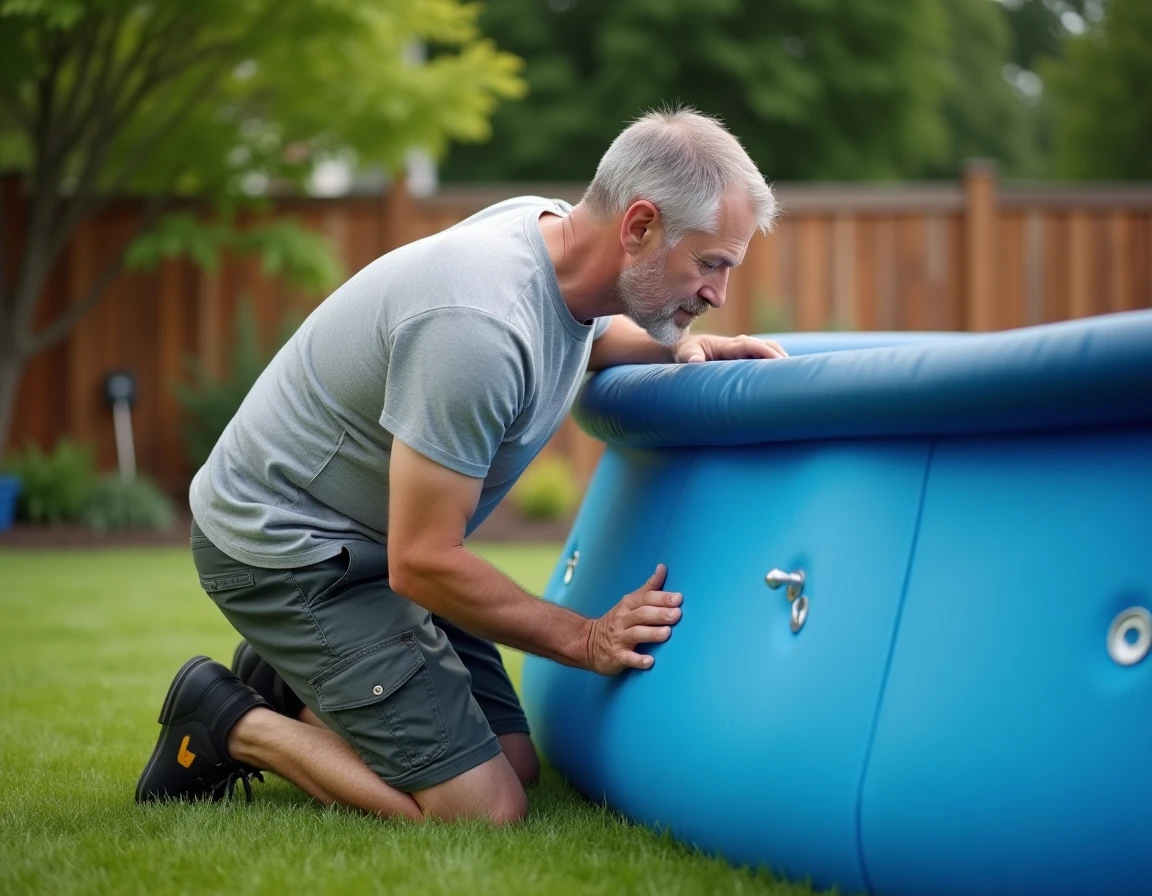
Your inflatable pool is leaning to one side, the water is touching the edge and threatening to overflow. This problem almost always occurs in the first few days after installation, when the weight of the water reveals an imperceptible unevenness. Before attempting anything, one precaution changes everything: the water level at the time of intervention.
Filling and safety threshold before any correction
You may have noticed that the pool seems straight when empty, but deforms as soon as it’s filled? It’s the weight of the water that pushes down the ground unevenly. The reflex to lift one side or dig under the base while the pool is full is the worst approach.
Manufacturers like Intex specify in their manuals that you should never attempt to straighten a pool filled to more than one-third. Beyond that, the mass of water weakens the seams of the liner and the edge. Forcing repositioning under these conditions voids the manufacturer’s warranty.
The DGCCRF also warns of the risk of sudden tipping when lifting or digging under one side without draining. The resulting wave of submersion poses a real danger, especially for children present around the pool. Therefore, before attempting to straighten a leaning inflatable pool, you must systematically drain down to the lower third of the volume.
Yes, losing several thousand liters of water is frustrating. But it’s the only method that protects both the structure and the users.
Preparing a stable ground for inflatable pools
The real problem is not the pool, it’s the ground underneath. An inflatable pool has no rigid frame: it conforms to the slightest irregularity. Correcting the tilt without addressing the ground only postpones the problem by a few days.
Identifying the sinking area
Once the pool is emptied and moved, place a bubble level (or a long batten with a level on top) across the entire surface. Identify the low areas. Often, only one side concentrates the unevenness, where the soil was softer or recently disturbed.
Leveling with compacted sand
Sand remains the most suitable material for compensating for a few centimeters of unevenness under a soft pool. Here’s the method that works:
- Lightly excavate the high areas with a flat shovel, then fill the low areas with slightly damp sand to facilitate compaction.
- Compact the surface with a roller, a manual tamper, or simply by methodically stepping on each area with a wide board.
- Check the level with a bubble level in several directions (crosswise and diagonally), then correct any remaining discrepancies before replacing the ground mat.
A gently sloping ground can also be leveled with a low formwork filled with well-compacted sand. The ground must be firm underfoot, not spongy.
Blocks, wedges, and inflatable cushions: false good ideas
For a few seasons now, leveling blocks and inflatable cushions “for above-ground pools” have been sold online as a quick solution. Why be wary of them for an inflatable pool?
A tubular pool rests on metal legs: each leg transmits the load to a specific point, which a block can effectively stabilize. An inflatable pool, on the other hand, rests on its entire contact surface. Placing a wedge under the edge creates a localized pressure point that deforms the soft bottom and concentrates stress on the liner.
Bestway and Intex explicitly discourage these devices for their soft inflatable ranges. Feedback from recent seasons confirms that sandbags or cushions placed under the edge provide temporary compensation but often create new deformations within a few weeks.
Checking the ground after each season
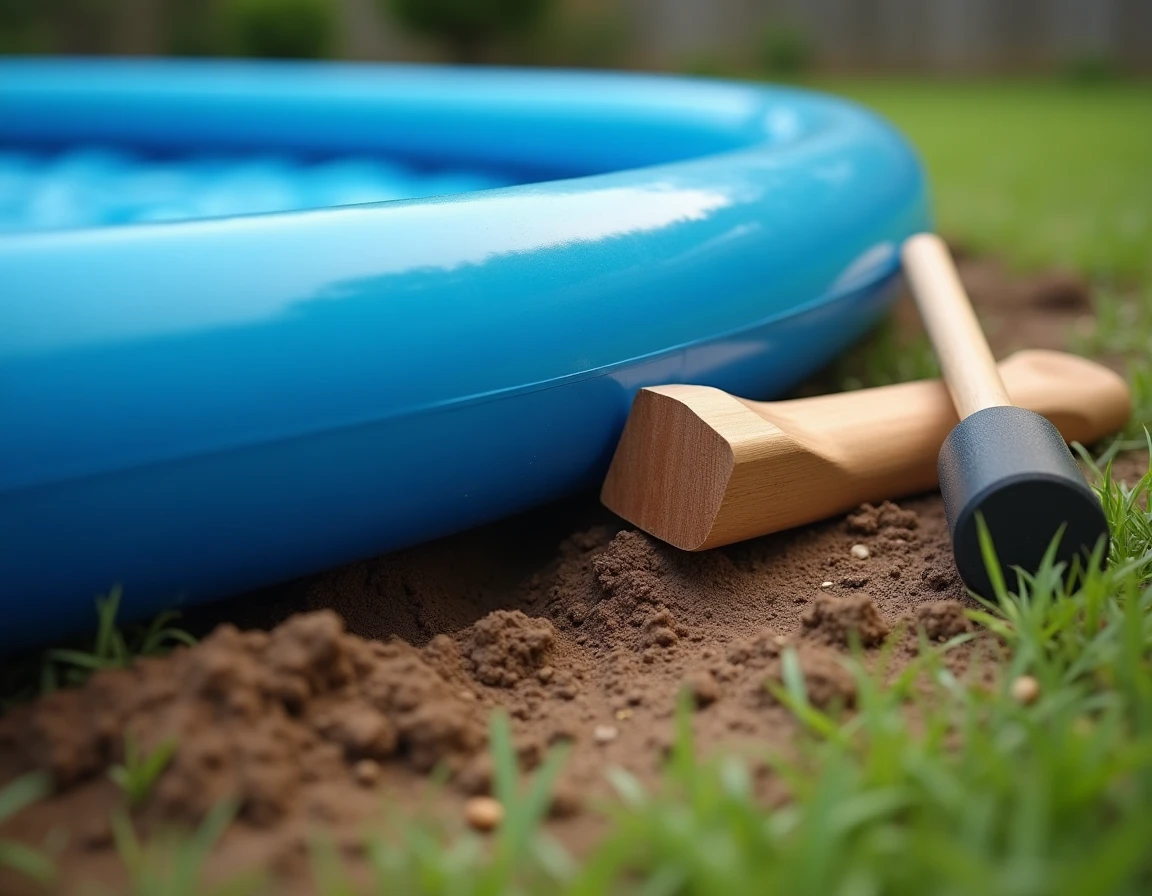
A perfectly leveled ground in June can shift during the summer. Rain and drought cycles alter the compactness of the soil, especially in clayey ground. The constant weight of the water accelerates differential settling.
Before each refilling, take control with the bubble level again. A few minutes of checking can prevent having to start all over again in mid-July. If your ground is naturally unstable, consider a stabilized sand slab (a sand-cement mix without water that hardens gradually) as a permanent base.
What insurers check in case of damage
In recent years, some home insurers (notably AXA, Groupama) exclude damages related to above-ground pools installed on a surface that does not comply with the manufacturer’s recommendations. Keeping the assembly manual and documenting the ground preparation (photos before installation) is a useful precaution in case of a claim.
The inflatable pool is the most accessible model, but also the least tolerant of ground defects. Taking the time to drain, level properly, and avoid shortcuts (wedges, cushions, manual lifting) remains the only approach that lasts over time.