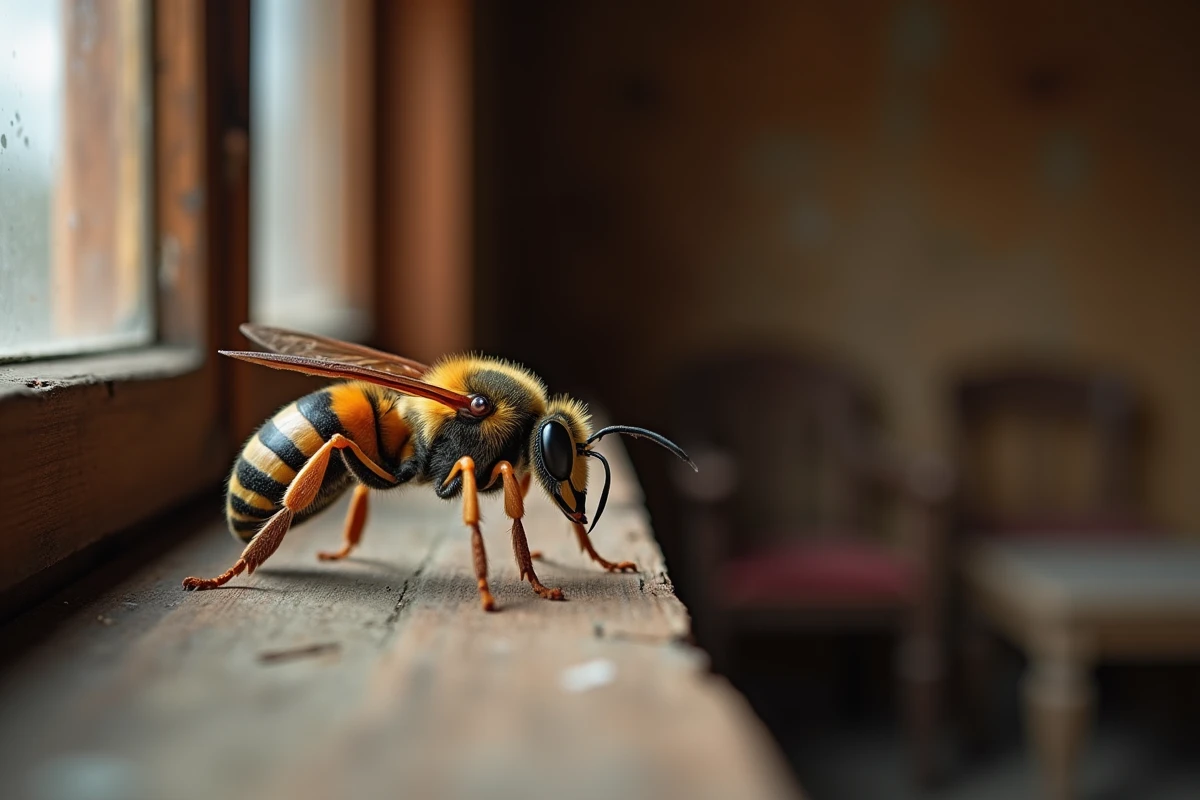
A wasp entering a living space triggers an immediate reaction, often disproportionate to the actual risk. Vespa crabro, the European hornet, measures about 35 mm for the queens and remains relatively non-aggressive outside the immediate vicinity of its nest. This unsolicited entry into the domestic space has, however, fueled a network of symbolic and spiritual readings for centuries that far exceeds the simple entomological question.
The hornet as an indicator of ecological imbalance around the home
Before addressing any spiritual interpretation, one fact deserves attention: a hornet in the house often signals a disturbed external environment. The scarcity of natural nesting sites, the fragmentation of hedges, tree felling, or heavy renovations displace colonies towards human dwellings.
This observation, relayed during the conference “Social Hymenoptera and Urbanization” organized by the Entomological Society of France in 2023, invites a reconsideration of the hornet’s presence. The insect does not “choose” a house at random. It is compelled there by the degradation of its ordinary habitat.
This ecological reading gives an unexpected depth to the symbol. The hornet becomes the messenger of an environment altered by human activity, forcing a forced coexistence with what has been displaced. To explore the spiritual and symbolic meaning of the hornet in the house, this grounded starting point offers a more solid framework than purely abstract interpretations.

Symbolism of the hornet in spiritual traditions
The hornet belongs to the family of social hymenoptera, just like the bee and the wasp. In symbolic reading frameworks, each member of this family carries a distinct message related to collective energy and territorial protection.
Power, defense, and affirmation
The hornet embodies an energy of active defense. Its imposing size, its ability to sting multiple times without dying (unlike the bee), and its role as a guardian of the colony make it a symbol of fierce protection. In several European animist traditions, its presence in a living space is interpreted as a call to defend one’s personal boundaries.
Where the bee symbolizes collective work and productive sweetness, the hornet refers to a more raw affirmation. It raises the question of boundaries: those of the home, those of the psychic space, those that one allows to be crossed without reacting.
The hornet in dreams
In symbolic dream analysis, the hornet frequently appears as a warning signal. Its dream presence is associated with:
- An unresolved conflict situation that demands direct action, not avoidance
- A warning regarding an invaded personal territory, whether it be a physical or emotional space
- A repressed energy seeking an outlet, sometimes with an intensity that surprises the dreamer
The hornet in a dream rarely invites passivity. It differs in this from the wasp, which is more often linked to diffuse irritation and repeated minor annoyances.
European hornet and Asian hornet: two different spiritual readings
The distinction between the European hornet (Vespa crabro) and the Asian hornet (Vespa velutina) is not merely entomological. It also carries its own symbolic weight.
The European hornet, present for centuries in our ecosystems, integrates into an ancient symbolic network. Its coexistence with humans is long, and the fears it evokes are often disproportionate. The popular saying that “three stings kill a horse” has no scientific basis, as entomologist Ignace Mariétan already pointed out in his works published in the Bulletin de la Murithienne.
The Asian hornet, on the other hand, is an invasive species that has recently appeared in Europe. Its symbolism is linked to intrusion, imbalance, and unanticipated external threat. For those who practice animal symbolic reading, encountering an Asian hornet in the house carries a more urgent message, related to a disturbance from the outside that disrupts an established order.
What the ethical stance towards the hornet reveals about our relationship with the living
The reaction to the hornet in the house acts as a revealer. To crush, capture, flee, or observe: each gesture reflects a relationship with the living world and, by extension, with what disturbs.
Since 2023, several French municipalities have been experimenting with protocols for ethical control of hornet nests: adapted intervention times, targeted products, methods reducing animal suffering. This concrete shift aligns with the ancient spiritual intuition that recommends not killing the visiting insect.
The symbolism here aligns with practice. Welcoming the presence of the hornet without panic (while guiding it outside) becomes an exercise in emotional management applicable far beyond entomology:
- Identifying the real threat (the European hornet rarely stings without direct provocation) rather than the perceived threat
- Responding with moderation instead of reacting out of fear
- Accepting that some disturbing presences carry useful information about the environment or oneself
The hornet in the house tests the ability to distinguish between real danger and emotional projection. This reading framework, whether termed spiritual or psychological, remains operational in both cases.
The next time a hornet crosses the threshold of a window, the first useful reflex remains the simplest: open the nearest exit wide. The second, less instinctive, is to ask what in the immediate environment or in one’s own life has displaced the usual boundaries.