
You have inherited a porcelain service, or you have just invested in beautiful white plates. The reflex after the meal: stack everything in the dishwasher. Does porcelain really withstand this treatment, or are you at risk of finding your decorations dulled after a few months?
Cooking temperature and glaze: what makes porcelain strong or vulnerable
To understand if your porcelain tableware can handle the dishwasher, we need to look back at its manufacturing. Porcelain is a ceramic fired at very high temperatures. This firing transforms the mixture of kaolin, sand, and feldspar into a dense, waterproof, and hard material.
Upon leaving the oven, the piece receives a glaze, a vitrified coating that makes it smooth and shiny. A well-stabilized glaze protects porcelain from chemical and mechanical aggressions. It is this layer that makes all the difference in the dishwasher.
Manufacturers of modern porcelain design their pieces to withstand domestic washing cycles. The glaze is formulated to endure temperature variations and detergents. When a manufacturer labels an item as “dishwasher safe,” it means that the glaze has been tested under these conditions. You can trust this without hesitation for those items.
To find out if porcelain is dishwasher safe, you need to examine the piece itself, not “porcelain” in general. Not all porcelains are equal when it comes to automatic washing.
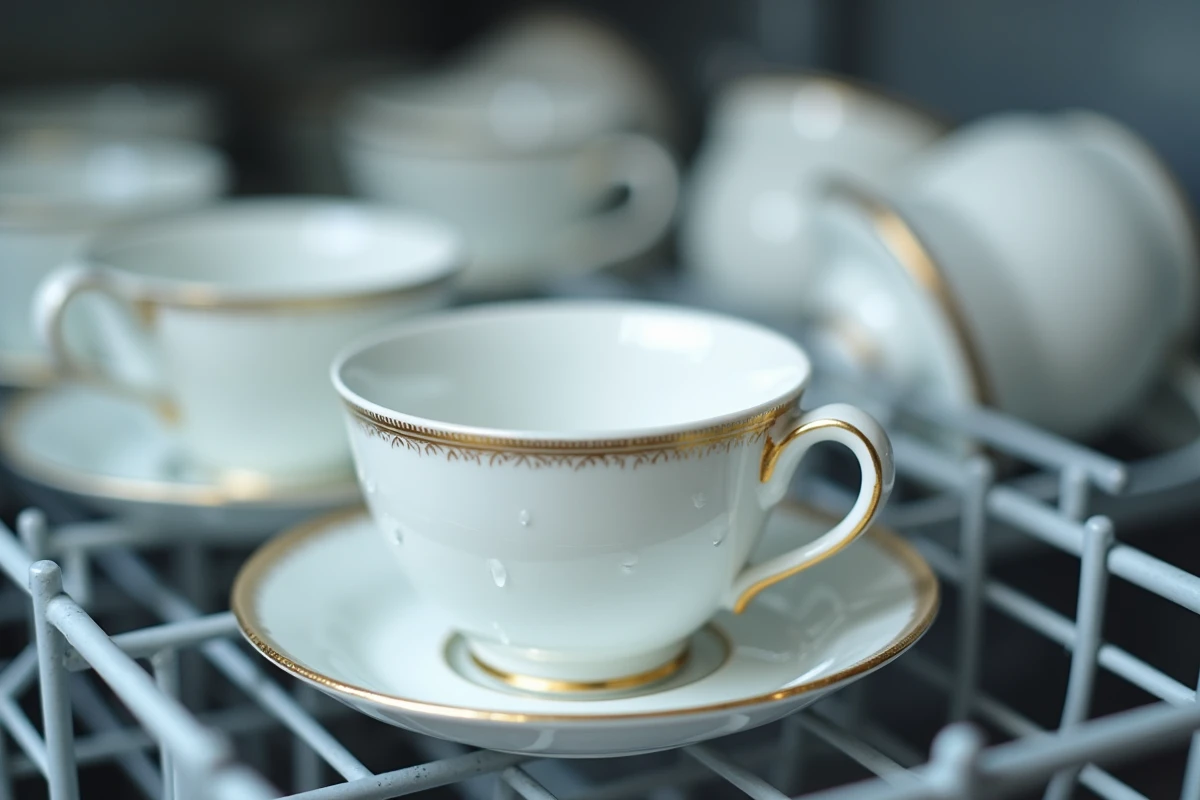
Antique porcelain and gilded decorations: the real risk cases
You may have noticed that the golden rims of some antique plates seem to fade over time? It’s not just an impression. Gold, platinum, or hand-painted decorations are applied on the glaze, not underneath. They remain exposed on the surface, without protection.
In the dishwasher, these decorations face a double aggression. First, alkaline detergents attack the pigments and precious metals. Then, the pressure water jets and the heat from drying accelerate wear. Over cycles, the gold becomes dull, then disappears in places.
Antique porcelain poses an additional problem. Period glazes were not designed to withstand modern products. A family service dating back several decades may have invisible micro-cracks in the glaze, called crazing. Water and chemical agents seep into these cracks and weaken the piece from the inside.
How to identify sensitive porcelain
- Run your finger over the decoration: if you feel a slight relief, the pattern is applied on the glaze and thus vulnerable to intensive washing.
- Look at the gilded or silvered edges: any irregularity, flake, or dulled area indicates wear that has already begun, which will worsen in the dishwasher.
- Check the underside of the plate: the absence of a “dishwasher safe” pictogram on a modern piece is a clear signal from the manufacturer.
All-in-one detergents and intensive cycles: what your machine inflicts on the dishes
The dishwasher does not damage porcelain on its own. It is the combination of detergent, temperature, and cycle duration that matters.
All-in-one tablets concentrate several aggressive chemical agents: degreaser, anti-limescale, rinse aid. This multifunction formula is convenient, but it is more corrosive than a gentle cleaning product used separately. The manuals of some recent devices even recommend avoiding these combined products for fragile pieces.
Temperature also plays a direct role. An intensive cycle can expose dishes to prolonged heat. The sudden variations between hot washing and ambient air when the door is opened create thermal shock. On well-vitrified porcelain, this shock remains harmless. On an antique piece or a surface decoration, it can cause micro-cracks.
Settings to prioritize to protect porcelain
- Select a short cycle or a “delicate” program if your device has one, with a moderate temperature.
- Prefer a powder or gentle liquid detergent rather than an all-in-one tablet on decorated pieces.
- Disable heat drying if possible, and leave the door ajar at the end of the cycle for air drying.
- Space the pieces in the baskets to avoid collisions between plates during washing.

Modern white porcelain and daily dishwasher use
For contemporary porcelain without metallic decoration, the dishwasher poses no real problem. Recent white porcelain, fired at high temperatures, tolerates thousands of cycles without visible degradation. This is also the case in professional catering, where porcelain plates go through the dishwasher several times a day.
In the professional sector, machines use calibrated cycles, with suitable cleaning products that limit the attack on the glaze. Domestic dishwashers do not always offer these settings, but the result remains satisfactory for quality porcelain designed for this use.
The selection criterion boils down to this: buy porcelain labeled dishwasher safe for daily use. Reserve hand washing for antique pieces, hand-decorated items, or those adorned with metallic fillets. This simple division protects each type of tableware without complicating your daily routine in the kitchen.
So the question is not whether “porcelain” is dishwasher safe. It’s about knowing what porcelain you own. A modern, uniform collection will withstand automatic washing for years. An inherited service with painted or gilded decorations deserves a few minutes of hand washing, with a soft sponge and a bit of warm water. This gesture is enough to preserve what the machine would eventually erase.